
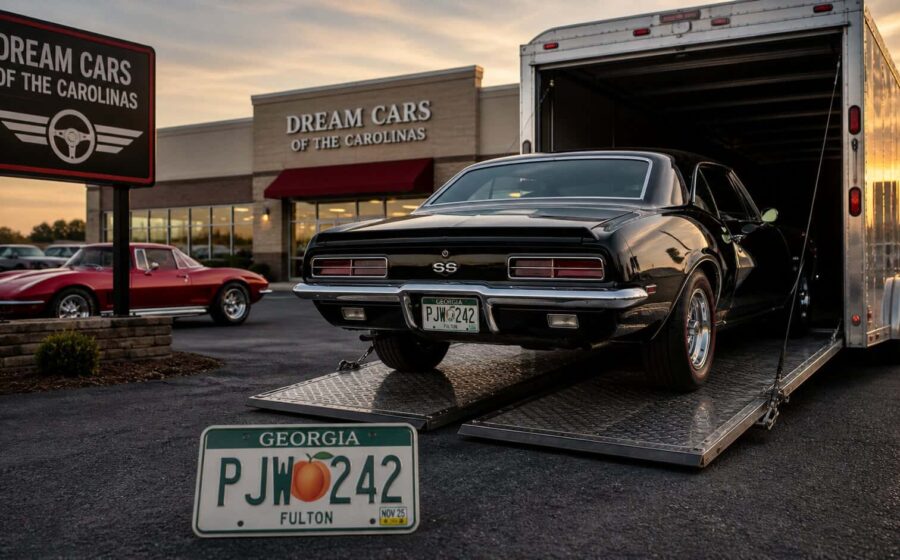
The Atlanta Pipeline: Georgia Plates Conceal Far More Than Carolinas Buyers Expect
Take any classic automobile transporter on a Monday morning trip up I-85 from Atlanta to Charlotte. Statistically speaking, whatever is being shipped was a Georgia-registered car a few days prior to shipment. Mecum Auctions’ Atlanta Spring and Atlanta Summer sessions at Atlanta Motor Speedway, Barrett-Jackson’s annual Southeast and Winter events, and the consistent stream of estates out of Atlanta, Newnan, Athens, and Peachtree City ensure that the inventory stream stays full year-round. For Carolinas classic and exotic dealers, that pipeline is well-understood. What they often under-appreciate is how much of that car’s full history could have been hidden under its last few Georgia plates before it ever made it out of the state.
Atlanta: Where Carolinas Inventory Begins Its Journey
The Southeastern classic and exotic market is not centered in Charlotte; it’s centered some 240 miles south. Mecum’s two Atlanta auctions each year feature deep, four-figure hammer counts on Cadillac, Mustang, Corvette, Mopar, and Ferrari consignments. Add to that the rest of the Atlanta-based auctions (Barrett-Jackson, for example) and a steady trickle of local estate-market sales out of the affluent neighborhoods of metro Atlanta. That’s why a car like a 1968 Coupe de Ville, coming onto a showroom floor after sale in Atlanta, represents such a risk for a Carolinas dealer: the title that goes with that car has Georgia jurisdiction, not North Carolina or South Carolina jurisdiction. Any due diligence done, and any car history lookup performed, should be focused on that state, not the one at the point of sale.
Georgia’s Title-Jumping Issues: What The Plate Lookup Uncovers
Georgia has a known issue with title-jumping that has been reviewed in state legislative inquiries and highlighted in official Georgia Department of Revenue advisories. The core issue: vehicles changing hands in a series of non-formalized private transactions without proper title transfer. By the time that car ends up at a licensed dealer, there could be one or two or three intermediate owners, all of whom do not appear on the title. However, the vehicle’s registration will show evidence of the title jumping process through discrepancies in owner records and reissuances of plates.
A Georgia license plate lookup based on a currently-held plate number will turn up any Georgia-based titles for the car, and any Georgia-based title status designations such as rebuilt, salvage, or theft-recovered. Even if the title is clear, a registration inquiry may reveal gaps, reissuances, and other inconsistencies that suggest that the seller is telling a partial story.
Georgia salvage shops rebuilding insurance write-off vehicles to a driveable standard are another part of the equation. There are concentrated centers of that activity in metro Atlanta around the I-20 and I-285 corridors. A portion of those vehicles gets re-sold locally, registered with a rebuilt designation, and sold out-of-state where the title designation may or may not be maintained. The registration record holds the rebuilt flag from the start of that journey, no matter how many jurisdictions the car moves through.
How To Read The Results: Four Critical Points Of Interest
There are four key points of information that can be found by querying Georgia registrations: Georgia-specific titles for the vehicle; accident records or any damage reported to the Georgia DMV; registration history that includes any gaps or reissuances; and finally, the latest plate attachment date that provides a baseline for confirming that the claimed provenance by the seller is accurate. In the case of a Georgia-dealership-sourced car that is intended for the Carolinas classic car showroom floor, those four points alone make the lookup worth the cost.
The fourth item – confirming that the claimed vehicle timeline by the seller matches the state-recorded registration timeline – becomes very valuable to a dealer very quickly. If the seller claims six years of ownership in his Atlanta garage, but the Georgia plate lookup returns three reissues in those six years and also a 2023 title-branding notice, that provides the dealer with valuable leverage. Most importantly, it gives the dealer reason to delay listing the car, rather than putting it immediately in front of an unsuspecting buyer.
That same leverage becomes even more important for the buyer of the car. Premium costs for auto insurance on a classic or exotic policy depend upon title-branding status. A rebuilt or salvage flag on that car would add four figures annually, or cause outright rejection by a specialty insurer. Seeing that flag on the plate lookup ahead of the deposit being wired would save far more money than a $50 inquiry charge.
Migration Pattern, Speed Of Document Review, And Reputation Risk
The Atlanta-Charlotte-Greenville classic automobile movement pattern is a well-established and long-standing reality of the Southeast market. What has shifted over the last ten years is the speed and availability of the documentation record. Queries that would have taken weeks or months of notarized requests back in 2013 now take place within hours and are available online. There is no longer a reason for a Carolinas classic dealer to list an Atlanta-sourced car without checking the Georgia record. Likewise, there is no longer a reason for a buyer to purchase such a car without verifying that history first.
The cars themselves and the auctions themselves are all perfectly real, legitimate, and healthy markets. However, the documentation that comes along with them is, at best, a single side of the story – the one preferred by the seller. The other side, which includes all state-level registrations, title brands, and history, sits only one inquiry away.