
Why Classic Buyers Don’t Do Owner Lookups – And Pay More Than They Have To
At one of last month’s Mecum Kissimmee sessions, a 1969 Cadillac DeVille convertible sold for more than $80k, with the consignment documents listing only two names on its title abstract. Checking that record against the actual owner history retrieved by the buyer’s broker afterward showed that the chassis had passed through six garages in four states since its original purchase, including a Florida title brand washed off in the 2014 re-title process. The sale was made anyway, but only after the buyer renegotiated the price down by $11,000.
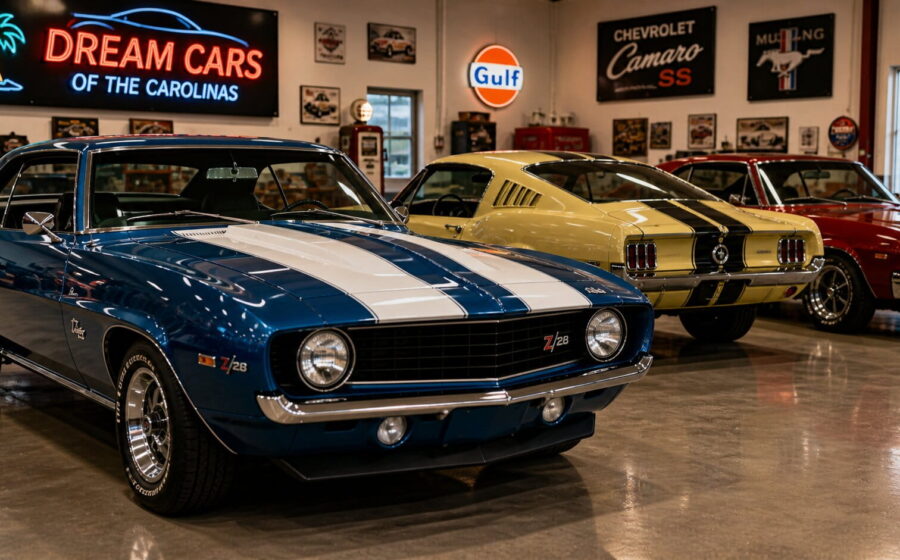
A classic auto purchase begins with the seller and ends with the chassis number, and the gap between those two end points holds the keys to either a secure deal or a future lawsuit. This happens in the Carolinas at least twice a week: a 1969 Camaro Z/28, a 1967 Mustang Fastback, a thin service binder with a handshake offer. Owner-lookup tools plug the hole.
Why “Only Two Names” Rarely Means “Only Two Owners”
A title abstract is not the same thing as an owner history. The former lists everything the DMV of the state in which the car was most recently registered knows about it. The latter digs into cross-state databases of registered cars, auctions, lien filings, and other vehicle histories. It becomes relevant mostly with cars that cross state lines, which are most classics worth buying.
A muscle car that was restored in California, then sold to an owner in Arizona, put through Barrett-Jackson Scottsdale, then sold again to North Carolina will show two or three names on its title abstract. The names of the shop that did the restoration in 2008, the storage company that kept it in Arizona, and any other custodian will only be accessible via owner history search. And those earlier custodians are exactly whom the buyer wants to contact in the case of a 1970 Hemi Cuda or numbers matching Z/28.
Title brands are also edited out of the picture in the same process. If the car was branded “Salvage” due to damage suffered during a hurricane strike reported in 2013 in Florida, it may lose the brand in subsequent re-titling in some other state with softer requirements for branding. It is still there in the NMVTIS database, but a simple check of the DMV’s records won’t find it anymore. If the buyer does not look past the title record, he or she will miss it completely.
How An Owner Lookup Actually Works
A modern way to find vehicle owner by VIN provides three levels of information that a potential buyer of a car listed for $60k to $400k in the Carolinas needs. The first level identifies the last registered owner of the car, thus establishing whether the seller is the car’s title owner or simply acts under a power-of-attorney contract for some other person. The second – the list of prior owners, typically 2-4 custodians depending on how many states the car has passed through since its original purchase, the names being obscured – provides a useful starting point for the next call to be placed. The third is a record of the title brands applied to the vehicle in multiple states, providing any existing salvaged status, evidence of an odometer roll back, and unreleased liens.
Checking the vehicle by VIN requires only a few minutes, and its cost is negligible compared to even a single meal in Charlotte. For a typical Carolinas classic auto purchase deal, the financial calculations aren’t even close.
Barn Find Or Auction Fresh?
Two common pitches used to sell a classic car in Carolinas are perfect candidates for an owner lookup that will either validate the transaction or prevent an unnecessary loss. The barn find pitch is based on a discovery of a previously undocumented car stored in a Tennessee barn and sold now by its grandson with minimal documentation and a few faded photos as additional proof. For the buyer, it means a choice of trusting the seller’s romantic story or declining it altogether.
However, an owner lookup that provides information about the car’s prior custodians opens additional possibilities. The first one is contacting the previous owner and confirming whether the car was stored in a heated environment or in one unheated, as well as learning how often it was started and whether there were any signs of flooding in its floor pans. This is exactly the information a potential buyer needs to decide whether or not paying extra for a numbers matching engine is justified.
The opposite case of “auction fresh” usually involves a quick resale after attending an Mecum or Barrett-Jackson auction. While fast turnover is common in the Carolinas classic market, questions remain about the details disclosed during the inspection period and about possible rebranding of the title upon reselling.
Thus, an owner lookup may reveal an old salvage brand, a discrepancy found at the time of the sale in Texas, or a lien on the car never released by an Ohio credit union – all facts that may serve as a good bargaining ground and even cause a transaction cancellation.
The Least Expensive Insurance in a Big Deal
A pre-purchase inspection by a certified classic vehicle specialist can cost between $400 and $1,200, but the cost of title and owner checks are far lower and complement the inspection process nicely. The inspector will verify the condition of the car, while the title history can answer questions about the car’s previous ownership, its state residency, and all the things that title searches may leave out.
Avoiding this procedure because of the cost of a tank of premium fuel can turn a six-figure purchase into a legal nightmare of buying a 1969 Camaro Z/28 that turns out to be a regular 1969 Mustang Fastback with a cowl tag.
Before the money leaves the escrow account on any classic car purchase, the vehicle’s history deserves an independent verification.