
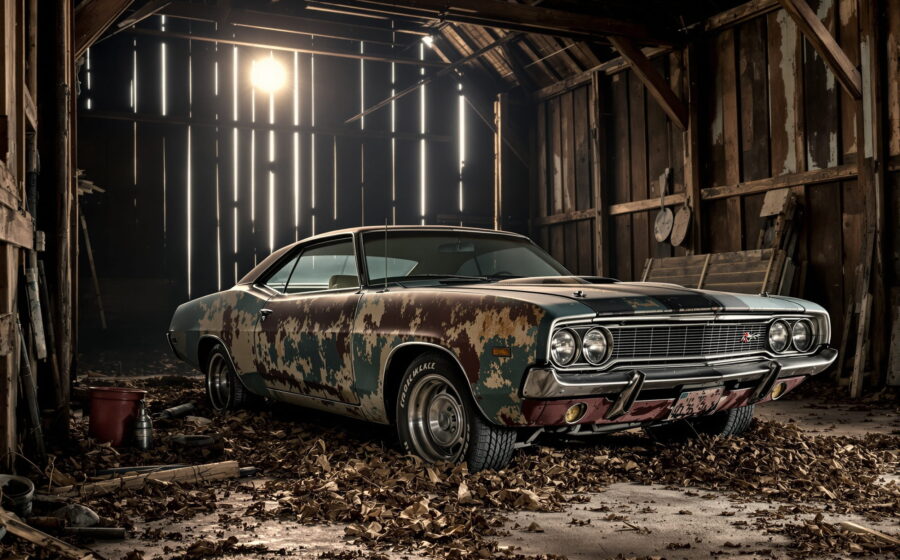
In what collectors are calling the barn find of the decade, a numbers-matching 1970 Plymouth Hemi Cuda was discovered in a rural North Carolina town, hidden away beneath decades of dust and forgotten boxes. For classic car enthusiasts, the rumor of a pristine muscle car sitting untouched in an old shed is a familiar tale. Most of these stories turn out to be myths or exaggerations. This time, the legend proved entirely real.
The Plymouth Hemi Cuda represents the absolute pinnacle of the American muscle car era. Finding one intact is incredibly rare. Finding one that retains its original, numbers-matching drivetrain after more than fifty years of obscurity is a monumental event in the automotive community.
This post explores the rich history behind the 1970 Hemi Cuda, details the astonishing condition of this specific North Carolina discovery, and explains why this single vehicle carries such massive significance for collectors around the globe.
The Legendary History of the 1970 Plymouth Hemi Cuda
To truly appreciate the magnitude of this discovery, you have to understand the environment that birthed the Plymouth Hemi Cuda. By the late 1960s, the American automotive industry was locked in a fierce horsepower war. Manufacturers were stuffing massive engines into mid-sized cars to satisfy a public hungry for speed and performance.
Plymouth recognized they needed a fresh platform to compete with the Ford Mustang and the Chevrolet Camaro. In 1970, they introduced the E-body platform. This new design gave the Plymouth Barracuda a wider, more aggressive stance that perfectly accommodated Chrysler’s most formidable power plants. The high-performance variant of the Barracuda was simply dubbed the “Cuda.”
The Elephant Engine
The heart of the Hemi Cuda was the legendary 426 cubic-inch Hemi V8 engine. Nicknamed the “Elephant” due to its massive physical size and overwhelming power, the 426 Hemi was originally designed for NASCAR racing. Chrysler eventually adapted it for street use to meet homologation requirements.
Officially rated at 425 horsepower and 490 lb-ft of torque, the 426 Hemi was an absolute powerhouse. Many automotive historians argue that Chrysler intentionally underrated the horsepower to appease insurance companies, with true output likely exceeding 500 horsepower. The engine featured dual four-barrel carburetors, a forged steel crankshaft, and hemispherical combustion chambers that allowed for massive airflow and exceptional performance.
A Rare Breed
Despite its fearsome reputation, the Hemi Cuda was not a massive sales success when it debuted. The 426 Hemi engine option was incredibly expensive, adding almost a third of the base car’s price to the final sticker. Furthermore, the massive engine required heavy-duty suspension upgrades, a specialized cooling system, and frequent tuning.
Because of the high cost and demanding maintenance, very few buyers opted for the Hemi package. Plymouth produced fewer than 700 Hemi Cudas for the 1970 model year. Fast forward fifty years, and attrition from racing crashes, rust, and neglect has significantly reduced that already small number. This extreme rarity is what makes any surviving Hemi Cuda a crown jewel in the automotive world.
Uncovering the North Carolina Barn Find
Discovering a classic car in a barn is a thrilling experience, but validating its authenticity requires meticulous inspection. When word spread about a potential Hemi Cuda resting in a dilapidated structure in rural North Carolina, skeptics immediately questioned if it was a genuine factory Hemi car or a later clone.
Authenticating a Numbers-Matching Masterpiece
The phrase “numbers-matching” is the golden ticket in the classic car market. It means that the vehicle still retains the exact engine block, transmission, and rear axle that it was assembled with at the factory.
Experts carefully examined the North Carolina Cuda, clearing away decades of grime to reveal the truth. The Vehicle Identification Number (VIN) starts with the crucial letter “R,” which Chrysler used specifically to designate a factory-built 426 Hemi car. Further inspection of the engine block revealed the serial numbers stamped into the metal perfectly matched the vehicle’s VIN. The heavy-duty four-speed manual transmission and the Dana 60 rear axle also carried the correct factory stamps. This Cuda is the real deal.
Preserved in the Dust
The condition of the car is a remarkable time capsule. The original High Impact paint—a vibrant shade known as Tor-Red—peeks through a heavy layer of dirt and oxidation. The interior, though smelling heavily of old vinyl and damp storage, remains entirely intact. The factory dashboard, steering wheel, and Hurst pistol-grip shifter are all present and unmodified.
While the car will require extensive mechanical work to run again, the body is shockingly solid. The dry environment of the specific barn prevented the severe rot that typically claims these vehicles. For a restoration expert, an unmolested canvas like this is far superior to a car that was improperly repaired or modified with aftermarket parts over the decades.
The Significance of the Discovery for Collectors
The collector car market operates on a straightforward principle of supply and demand. The supply of genuine 1970 Hemi Cudas is static, and the demand only grows as these cars solidify their status as pieces of American history.
Survivor Status vs. Restoration
This North Carolina discovery sparks a fascinating debate within the collector community regarding what to do next. Traditionally, a car in this state would undergo a complete rotisserie restoration. Every nut and bolt would be removed, cleaned, and reassembled to make the car look better than it did the day it left the factory floor.
However, the current trend in classic car collecting heavily favors “survivors.” A survivor is a vehicle that retains its original paint, interior, and mechanical components, showing its age and history proudly. Many collectors argue that an original car can only be original once. Restoring it erases the unique patina and the incredible story of its fifty-year hibernation. Because this specific Cuda is so well-preserved, leaving it as a running, driving survivor might actually command a higher premium at auction.
Market Impact
When a genuine, numbers-matching 1970 Hemi Cuda crosses the auction block, the bidding routinely reaches into the millions. The presence of a four-speed manual transmission makes this particular car even more desirable. The discovery of a completely undocumented, original Hemi Cuda sends ripples through the market. It forces historians to update their registries and gives hope to every enthusiast who drives past an old, sagging barn on a country road.
This car serves as a physical reminder of an era when automotive engineers pushed the limits of naturally aspirated performance. It represents a bold, unapologetic period of American manufacturing that will never be replicated.
A New Chapter for an American Icon
The unearthing of this 1970 Plymouth Hemi Cuda in North Carolina proves that automotive treasures are still out there, waiting patiently in the dark. As this magnificent machine moves from a dusty shed to a prominent place in the collector world, it carries with it the rich heritage of the muscle car golden age.
Whether the new owner decides to undertake a meticulous concourse restoration or preserve the car exactly as it was found, the legacy of this Hemi Cuda is secure. Keep an eye on major classic car auctions over the next few years, as this remarkable survivor is bound to make headlines once again. If you have a passion for automotive history, start researching the forgotten garages in your own area. You never know what incredible piece of history might be hiding just behind the next set of barn doors.